Postdoctoral Training - Psychological & Brain Sciences
Massachusetts Institute of Technology - 2009
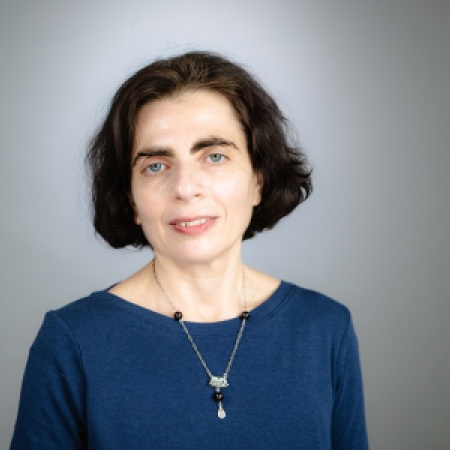
Ioulia Kovelman
Nelle C Johnston Chair in Communications Disorders in Children
Professor - Department of Speech, Language, and Hearing
Dr. Ioulia Kovelman is a developmental cognitive neuroscientist whose research examines child language, literacy, and brain development, with particular attention to bilingual learners and at-risk learners such as those with dyslexia.
972-883-3134
Office: CR 1.336
Curriculum Vitae
ORCID
Currently accepting undergraduate and graduate students
Professional Preparation
PhD - Psychology
Dartmouth College - 2006
Dartmouth College - 2006
BA - Psychology
Queen's University, Canada - 2000
Queen's University, Canada - 2000
Research Areas
Bilingual brain
Research focused on how experience with multiple languages influences children's language, literacy, and brain development.Reading & dyslexia
Research focused on how children's minds and brains develop for learning to read and how to better support children with learning differences and dyslexiaNeurobiology of language development
Research focused on the interaction between biological and environmental factors that shape children's language developmentPublications
Can the Simple View of Reading Inform the Study of Reading Comprehension in Young Spanish Heritage Language Learners? 2025 - Journal Article
Functional connectivity fingerprints of emerging reading skill in the first months of schooling 2025 - Other
Developmental changes in phonological awareness in Chinese-English bilingual children: An fNIRS longitudinal study 2025 - Journal Article
Neural processing of children’s theory of mind in a naturalistic story-listening paradigm 2025 - Journal Article
Cross-linguistic transfer in bilingual children's phonological and morphological awareness skills: a longitudinal perspective 2025 - Journal Article
Lexical Morphology as a Source of Risk and Resilience for Learning to Read With Dyslexia: An fNIRS Investigation 2024 - Journal Article
Awards
Rising STARs - University of Texas at Dallas [2026]
Amy L. and Kirk L. Wolfe Education and Mentorship Prize - University of Michigan [2024]
John Dewey Undergraduate Education and Mentorship - University of Michigan [2023]
American Psychological Society Fellow - APS [2023]
Harrington Fellowship - University of Texas at Austin [2016]
Appointments
Sponsored Faculty Affiliate
University of Michigan, Department of Psychology [–Present]
University of Michigan, Department of Psychology [–Present]